
Forfeiture of Lease Leads to Vacated Industrial Unit Re-Entered and Secured in Liverpool
Related Services
Team Members Involved


The Situation
A landlord holding a commercial lease on an industrial unit on a trading estate near Liverpool needed to take back possession of the premises. The landlord’s power of re-entry under the lease was available to exercise following non-payment of rent. What the landlord did not have was certainty about the state of the unit, whether anyone was still occupying it, or what had been left inside.
That uncertainty is the difficulty with any forfeiture. Re-entry has to be peaceable, it has to be properly documented, and if goods remain on site the landlord cannot simply dispose of them. Handled badly, a re-entry exposes the landlord to a claim over the tenant’s property or to an allegation that entry was not lawfully made. The landlord needed the unit back, secured, and the position on any remaining goods put on a proper legal footing from the first day.
After searching for forfeiture of lease specialists in Liverpool, the client contacted Strikes Property Services Group.
Our Approach
We scheduled the attendance for first light. Our enforcement agent arrived on site at 5.50am and met the instructed locksmith at the unit. Attending early on a trading estate serves a practical purpose on a forfeiture: it reduces the likelihood of encountering staff or contractors arriving for the day, and it means the re-entry can be completed calmly rather than in front of an audience.
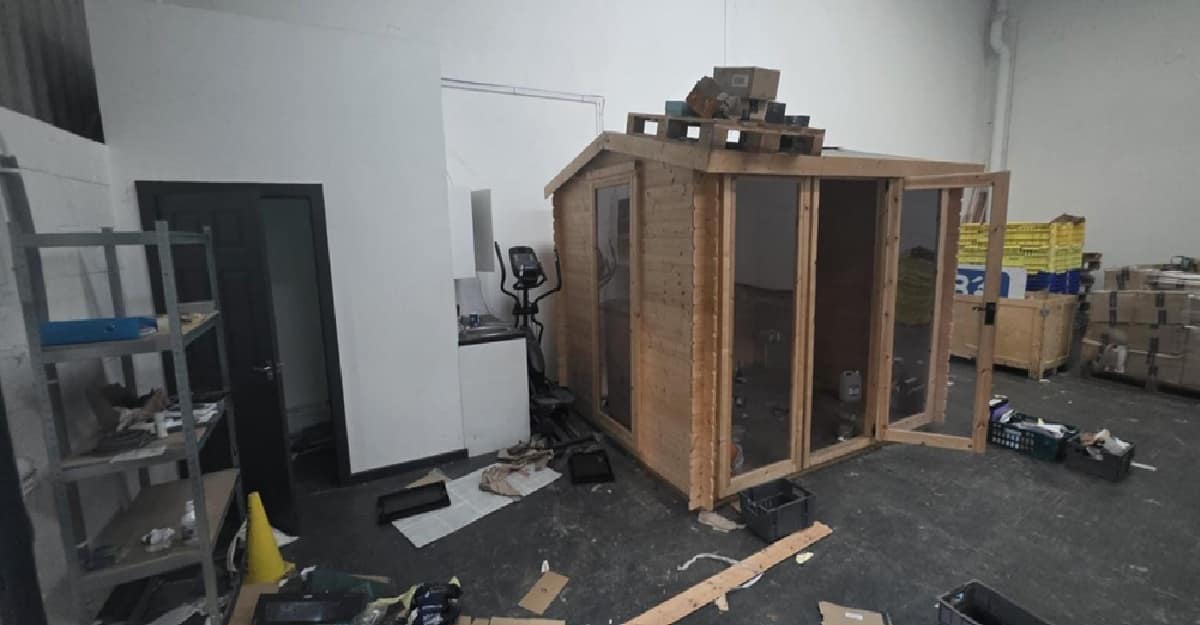
On arrival our agent established that the unit had already been vacated. Entry was gained through the existing Euro cylinder lock, with no force used and no damage caused to the door or frame. Our agent then completed a full photographic inventory of the interior. This is the step that protects the landlord. A quantity of goods had been left behind, including stock crates, pallets, fittings and a partly assembled timber structure, and a dated visual record of exactly what was present at the moment of re-entry is what allows the landlord to answer any later dispute about the tenant’s property.
With the inventory complete, the locksmith changed the Euro cylinder and disabled the roller shutter from the inside, securing the unit against both entrances. Our commercial locksmith services are run alongside the enforcement attendance for exactly this reason, so the premises are never left in an intermediate state between the tenant losing access and the landlord gaining it. The electricity meter was read and the reading recorded, drawing a clean line under the tenant’s liability for supply from the point of re-entry.
Because goods remained on site, we served notices at the entrance to the unit under the Torts (Interference with Goods) Act 1977: formal notice that the goods were ready for delivery, and notice of our client’s intention to sell. The notices set a 21-day window for collection and gave the tenant a route to arrange access through us. That put the landlord in a position to deal with the contents lawfully if nothing was collected, rather than being left holding another party’s property indefinitely. Keys were handed to estate security at the main gate so the landlord had immediate, documented access, and our team left site at 6.40am.
Outcome
The whole attendance took 50 minutes. The unit was re-entered without force, fully inventoried, secured at both the pedestrian door and the roller shutter, metered and handed back to the landlord’s control before 7am. No police attendance was required, there was no confrontation, and no damage was caused to the premises.
The landlord came away with more than an empty unit. Photographic evidence of the condition and contents at the point of re-entry, a documented meter reading, notices properly served over the goods left behind and a clear collection deadline all meant the position was defensible from day one and the unit could be brought back to market without an unresolved question hanging over it. The case was managed by Tom Coyle (Enforcement Agent) and Chris Bane (Managing Director), with Janet Morris supporting throughout, ensuring the re-entry was completed lawfully, quietly and in a single early-morning visit.